Conical burr vs flat burr grinder: what is the difference?
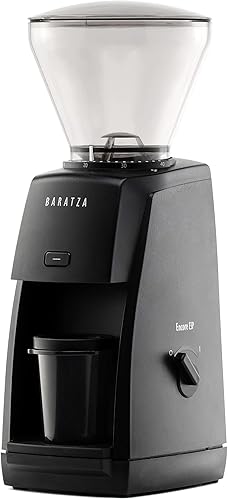
A conical burr grinder uses one cone-shaped burr that rotates inside a ring burr. Beans feed by gravity from the hopper and are crushed between the cone and the ring. Conical burrs operate at lower RPM, generate less heat and retain less ground coffee between uses (less dose waste). A flat burr grinder uses two horizontal disc-shaped burrs facing each other. Beans are forced horizontally through the gap between the discs. Flat burrs produce a more uniform particle size distribution at any given setting, which is why flat burr grinders are preferred in specialty coffee for filter brewing and at the top end for espresso. In practical home use, the difference between a quality conical burr (Baratza Encore) and a quality flat burr (Fellow Ode) is noticeable primarily in pour-over and filter brew methods where particle size uniformity matters most. For French press and drip coffee, a quality conical burr is fully adequate.
What grind setting should I use for pour-over?
For pour-over coffee (Hario V60, Chemex, Kalita Wave), the target grind is medium-fine: finer than drip but coarser than espresso. On a Baratza Encore's 40-step scale, medium-fine pour-over is approximately settings 15 to 25 depending on the specific pour-over device and coffee. Finer settings (15 to 18) suit slower-draining devices and lighter roasts. Coarser settings (20 to 25) suit faster-draining devices and darker roasts. The best indicator is brew time: for a typical 300ml V60 pour-over, a total brew time of 2.5 to 3.5 minutes indicates the grind is in the correct range. Under 2 minutes suggests grind is too coarse: increase fineness. Over 4 minutes suggests grind is too fine: decrease fineness. Adjust one setting at a time between brews. On a Capresso Infinity 16-step scale, medium-fine pour-over is approximately settings 5 to 7.
Should I grind coffee fresh or buy pre-ground?
Grinding coffee fresh before brewing produces better results than using pre-ground coffee. Coffee begins losing aromatics from the moment it is ground: volatile flavor compounds in ground coffee oxidize and evaporate rapidly at room temperature. Studies of coffee freshness show that ground coffee loses detectable flavor within 15 minutes of grinding when left exposed to air. Pre-ground coffee in sealed bags preserves some freshness through nitrogen flushing, but the quality at the time of brewing is still lower than fresh-ground from the same beans. The improvement from grinding fresh is most noticeable in pour-over and espresso, where grind freshness contributes directly to cup brightness and aroma. For drip coffee drinkers, the improvement from grinding fresh is real but less dramatic. Any burr grinder, even an entry-level Cuisinart or Capresso, produces fresher coffee than pre-ground when used daily.