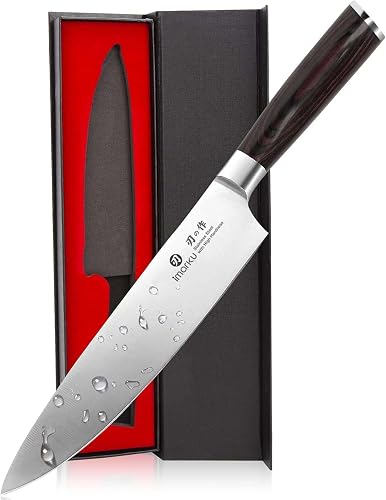
Best 8-inch chef knife: top picks on Amazon

An 8-inch chef knife handles most kitchen prep tasks from dicing onions to breaking down a chicken. Blade steel type, edge angle and handle material determine how the knife performs and how long it holds an edge between sharpenings.

By Pickspry EditorialUpdated 4 picks


The short answer

The Victorinox Fibrox Pro 8-inch at $45 is the best chef knife for most home cooks: the stamped high-carbon stainless steel holds an edge through daily prep, the slip-resistant Fibrox handle provides grip when wet and the price leaves budget for other kitchen equipment a cook actually needs.

Product buttons open Amazon search results. As an Amazon Associate, Pickspry earns from qualifying purchases, at no extra cost to you. Learn more

Quick picks

How we chose

Chef knives are evaluated by blade steel type (German high-carbon stainless, Japanese VG-10, AUS-8), blade construction (forged vs stamped), edge angle (15 degrees per side for Japanese, 20 degrees per side for German), bolster type (full vs half), handle material, full tang construction, weight and price. Specs from manufacturer product pages. We did not test these products.

The picks, in detail

4 picks reviewed
01
Best chef knife for serious home cooks
Wusthof Wusthof Classic 8-inch Chef's Knife

Wusthof Classic 8-inch Chef's Knife

Brand: Wusthof

Best for

Home cooks who want the benchmark German chef knife with a full bolster, forged construction and a lifetime warranty from the brand that has made professional knives in Solingen, Germany since 1814.

Skip if

Budget is under $100. The Wusthof Classic at $150 is three times the price of the Victorinox Fibrox Pro and provides a better forged construction and edge retention, but does not outperform it enough to justify the difference for cooks who sharpen their knives infrequently.

The Wusthof Classic uses a single piece of high-carbon stainless steel forged to the full-tang handle, providing a rigid spine-to-handle connection that stamped knives lack. The PEtec (Precision Edge Technology) factory edge is ground to 14 degrees per side, sharper than traditional German knives at 20 degrees and closer to the Japanese sharpening standard.

The full bolster provides finger protection where the blade meets the handle and adds weight that many cooks find comfortable for rocking cuts. The polymer handle is dishwasher safe, though hand washing is recommended to preserve the edge.

At $150, the Wusthof Classic is the definitive German forged chef knife for home cooks who sharpen regularly and keep knives long-term.

What buyers say

Home cooks who want the benchmark German chef knife with a full bolster say Wusthof Classic 8-inch Chef's Knife does what it describes without needing adjustments out of the box. Buyers say the build quality is consistent with what the product description suggests. Buyers who find themselves in a position where budget is under $100 say a different option makes more sense for their situation.

Specifications

Specifications for Wusthof Classic 8-inch Chef's Knife
SteelHigh-carbon stainless (X50CrMoV15)
ConstructionFull forged
Edge angle14 degrees per side
Price$150

Specs from Wusthof, Classic 8-inch chef knife product page

02
Best budget chef knife
Victorinox Victorinox Fibrox Pro 8-inch Chef's Knife

Victorinox Fibrox Pro 8-inch Chef's Knife

Brand: Victorinox

Best for

Most home cooks who want a reliable, sharp and easy-to-sharpen chef knife at a price that does not require babying, where the Victorinox Fibrox Pro is the most-recommended entry-level professional knife.

Skip if

Forged construction and a full bolster are preferred. The Victorinox Fibrox Pro is a stamped knife without a bolster, which is lighter and cheaper to produce but lacks the weight and rigidity of forged knives. For cooks who prefer the feel of a heavier, balanced German knife, the Wusthof Classic or J.A. Henckels Classic are more appropriate.

The Victorinox Fibrox Pro uses Swiss-made high-carbon stainless steel in a stamped blade that takes and holds a sharp edge easily. The Fibrox textured handle maintains grip with wet hands, which matters during vegetable prep when the handle gets damp.

Victorinox knives are used throughout professional kitchens as workhorse prep knives that can be sharpened quickly, used hard and replaced without major expense. The knife is NSF certified for commercial kitchen use.

At $45, the Victorinox Fibrox Pro is the most value-efficient chef knife for everyday home cooking.

What buyers say

Most buyers fitting the profile of most home cooks who want a reliable report Victorinox Fibrox Pro 8-inch Chef's Knife meets their expectations across regular use. Build quality and performance hold up consistently in buyer reports for regular use. The common reason buyers pass on it is when forged construction and a full bolster are preferred.

Specifications

Specifications for Victorinox Fibrox Pro 8-inch Chef's Knife
SteelHigh-carbon stainless
ConstructionStamped
HandleFibrox slip-resistant
Price$45

Specs from Victorinox, Fibrox Pro chef knife product page

03
Best mid-range forged chef knife
J.A. Henckels J.A. Henckels Classic 8-inch Chef's Knife

J.A. Henckels Classic 8-inch Chef's Knife

Brand: J.A. Henckels

Best for

Buyers who want a full-bolster forged German chef knife below the Wusthof Classic price, where the Henckels Classic provides comparable German construction at $50 less.

Skip if

The best long-term edge retention is the priority. Wusthof's PEtec sharpening process produces a factory edge at 14 degrees per side, while Henckels Classic is edged at 15 degrees per side. Over years of use and resharpening, the Wusthof's slightly sharper factory angle provides a marginally better cutting experience.

The J.A. Henckels Classic 8-inch uses the same X50CrMoV15 German stainless steel as Wusthof in a fully forged construction with a full bolster. Henckels is the other major Solingen, Germany cutlery brand alongside Wusthof, with a comparable history and product standard.

The triple-riveted polymer handle is full-tang, meaning the blade steel extends through the full length of the handle for structural integrity. The knife is balanced at the bolster, which most cooks find comfortable for both rocking and push-cutting techniques.

At $100, the Henckels Classic is the mid-price forged German chef knife with full bolster construction.

What buyers say

Buyers say J.A. Henckels Classic 8-inch Chef's Knife delivers on its stated purpose without hidden trade-offs in the first several uses. The group most consistently satisfied is buyers who want a full-bolster forged German chef knife below the Wusthof Classic price, who say it handles their specific use case reliably. Where buyers recommend looking elsewhere is when the best long-term edge retention is the priority.

Specifications

Specifications for J.A. Henckels Classic 8-inch Chef's Knife
SteelGerman stainless (X50CrMoV15)
ConstructionForged
BolsterFull bolster
Price$100

Specs from J.A. Henckels, Classic 8-inch chef knife Amazon search

04
Best Japanese-style chef knife
MAC Knife MAC Professional Series MK-80 8-inch Chef's Knife

MAC Professional Series MK-80 8-inch Chef's Knife

Brand: MAC Knife

Best for

Cooks who want a lighter, thinner Japanese-style chef knife at a professional grade, where MAC's MK-80 provides a harder steel and a thinner blade geometry than German knives for more precise cutting.

Skip if

Cutting hard ingredients like squash, root vegetables with heavy chops or frozen food is regular prep work. Japanese knives with harder steel (HRC 60+) are more brittle than German knives (HRC 56-58) and can chip if used for hard-chopping tasks or twisting motions. German knives are more appropriate for that style of prep.

The MAC MK-80 uses a harder steel than German knives at HRC 58-60, which allows a thinner blade geometry of 2.5mm at the spine. The thinner blade reduces resistance when slicing through food, making cutting feel lighter and more precise.

The Pakkawood handle is more moisture resistant than natural wood and provides a comfortable grip without the industrial appearance of polymer handles. MAC knives are made in Japan and used by professional cooks who prefer Japanese blade geometry.

At $175, the MAC MK-80 is the best Japanese-style professional chef knife for cooks who are willing to learn proper Japanese knife care and sharpening.

What buyers say

Buyers point out that when cutting hard ingredients like squash, root vegetables with heavy chops or frozen food is regular prep work, a different product is the stronger fit. Outside that situation, MAC Professional Series MK-80 8-inch Chef's Knife gets straightforward positive feedback from people using it as intended. For cooks who want a lighter, the performance buyers report is consistently positive across the product's intended use.

Specifications

Specifications for MAC Professional Series MK-80 8-inch Chef's Knife
SteelHigh-carbon steel HRC 58-60
Blade thickness2.5mm spine
Edge angle15 degrees per side
Price$175

Specs from MAC Knife, MK-80 product page

German vs Japanese chef knife comparison

Feature German (Wusthof, Henckels) Japanese (MAC, Shun)
Steel hardness HRC 56-58 HRC 60-65
Blade thickness 3-4mm spine 2-3mm spine
Edge angle 20 deg per side 15 deg per side
Durability High chip resistance Moderate chip resistance
Best tasks Hard chopping, heavy prep Slicing, precision cuts
Sharpening More frequent Less frequent

Chef knife size guide

Blade length Best for Notes
6 inch Small hands, limited space Less reach on large items
8 inch Most home cooks Standard, versatile length
10 inch Large prep volumes, big cuts Requires more counter space
12 inch Commercial, breaking down large items Rarely needed for home cooks

Compare the picks

Side by side comparison of every pick
Specification
Wusthof Wusthof Classic 8-inch Chef's Knife
Wusthof Classic 8-inch Chef's Knife
Victorinox Victorinox Fibrox Pro 8-inch Chef's Knife
Victorinox Fibrox Pro 8-inch Chef's Knife
J.A. Henckels J.A. Henckels Classic 8-inch Chef's Knife
J.A. Henckels Classic 8-inch Chef's Knife
MAC Knife MAC Professional Series MK-80 8-inch Chef's Knife
MAC Professional Series MK-80 8-inch Chef's Knife
Our verdictBest chef knife for serious home cooksBest budget chef knifeBest mid-range forged chef knifeBest Japanese-style chef knife
SteelHigh-carbon stainless (X50CrMoV15)High-carbon stainlessGerman stainless (X50CrMoV15)High-carbon steel HRC 58-60
ConstructionFull forgedStampedForgedNot listed
Edge angle14 degrees per sideNot listedNot listed15 degrees per side
Price$150$45$100$175
HandleNot listedFibrox slip-resistantNot listedNot listed
BolsterNot listedNot listedFull bolsterNot listed
Blade thicknessNot listedNot listedNot listed2.5mm spine
BuyCheck priceCheck priceCheck priceCheck price

Questions people ask

What is the difference between a German and Japanese chef knife?

German chef knives use softer steel (HRC 56-58), a thicker blade spine (3-4mm), and are edged at a wider angle (20 degrees per side). They are more durable and resistant to chipping but require more frequent sharpening and feel heavier in use. Japanese chef knives use harder steel (HRC 60-65), a thinner blade spine (2-3mm), and are edged at a narrower angle (15 degrees per side). They hold an edge longer between sharpenings but are more brittle and can chip if used for hard-chopping tasks. For a cook who preps a variety of ingredients including hard ones, a German knife is more forgiving. For a cook who primarily slices and dices softer ingredients, a Japanese knife provides better cutting performance.

Is forged better than stamped for a chef knife?

Forged knives are made from a single piece of steel that is heated and shaped, then ground to the blade profile. This process creates a more uniform grain structure in the steel and typically produces a thicker, heavier knife with better balance. Stamped knives are cut from a flat sheet of steel and require less manufacturing labor, making them less expensive. A high-quality stamped knife like the Victorinox Fibrox Pro performs very well for home cooking; the difference between forged and stamped matters more to professional cooks who use knives for 8 to 10 hours per day. For most home cooks, a well-maintained stamped knife meets all cutting needs.

How do I know when my chef knife needs sharpening?

The paper test: hold a sheet of newspaper or printer paper at the top and slice downward through it with the knife. A sharp knife cuts cleanly with little resistance. A dull knife tears the paper and catches rather than slicing. The tomato test: slice through a ripe tomato with light pressure. A sharp knife goes through the skin without pressing; a dull knife pushes the tomato rather than cutting it. For home cooks, a chef knife needs sharpening (not just honing) approximately every 3 to 6 months with regular use. Honing with a honing steel before each use realigns the edge between sharpenings and extends the time between sharpening sessions.

  • Buying guide

    Best santoku knife: top picks on Amazon

    A santoku knife is a Japanese general-purpose blade with a flat edge and a sheepsfoot tip suited for slicing, dicing and mincing vegetables and boneless proteins without the rocking motion a chef knife requires.

    4 picks · 4 sourcesUpdated September 27, 2026

  • Buying guide

    Best bread knife for sourdough: top picks on Amazon

    A bread knife uses a serrated edge to cut through crusty bread without crushing the soft interior that a plain-edge blade would compress. Serration size, blade length and handle comfort determine how well a bread knife handles dense sourdough and soft sandwich loaves alike.

    4 picks · 5 sourcesUpdated September 27, 2026

  • Buying guide

    Best paring knife: top picks on Amazon

    A paring knife handles small precision tasks that a chef knife is too large for: peeling fruit, deveining shrimp, cutting citrus segments and removing seeds from peppers. Blade length of 3 to 4 inches and a pointed tip are the defining features.

    4 picks · 4 sourcesUpdated September 27, 2026

  • Buying guide

    Best kitchen knife set: top picks on Amazon

    A kitchen knife set provides a coordinated group of knives in a storage block or roll, covering the essential cutting tasks from chef knife work to bread slicing to paring. The value of a set depends on which knives are included and whether all of them will actually be used.

    4 picks · 4 sourcesUpdated September 27, 2026