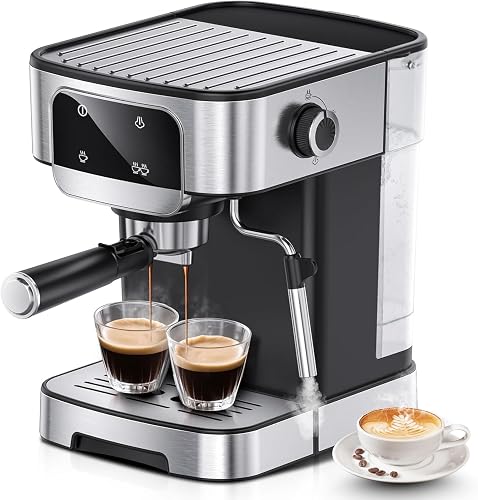
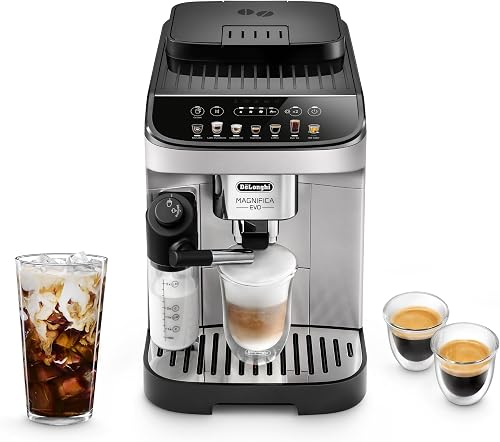
Coffee shop espresso machines: from startup cart to self-serve cafe

The right coffee shop espresso machine depends on your volume, your staff skill level and your budget. These cover the realistic range.

By Pickspry EditorialUpdated 4 picks


The short answer

For a high-volume self-serve coffee bar or cafe kiosk, the Jura Giga X Pro handles 200 cups daily with automated operation and no barista required. For a specialty micro-coffee shop with a trained barista producing craft espresso, the Rancilio Silvia Pro X brings dual stainless steel boilers and commercial 58mm group head at a price accessible for a small business.

Product buttons open Amazon search results. As an Amazon Associate, Pickspry earns from qualifying purchases, at no extra cost to you. Learn more

Quick picks

How we chose

Coffee shop espresso machines available on Amazon range from prosumer semi-automatics suited to micro-roasteries and startup carts to fully automatic commercial machines designed for food service volumes. We compared machines by daily volume capacity, operator skill requirement, construction quality and serviceability. Specs from manufacturer pages. We did not test these machines ourselves.

The picks, in detail

4 picks reviewed
01
Best for high-volume self-serve coffee shop
Jura Jura Giga X Pro

Jura Giga X Pro

Brand: Jura

Best for

A self-serve coffee bar, cafe kiosk or food service setup where 100-200 cups daily are needed and no dedicated barista is operating the machine.

Skip if

You operate a specialty coffee shop where barista control of extraction defines the product. The Giga X automates the full process and removes user control of extraction parameters.

The Jura Giga X Pro is built for commercial environments where volume and consistency are the primary requirements. Dual 500g hoppers with independent grinders allow regular and decaf to run simultaneously without reconfiguration, which matters in a coffee bar where customers have different requirements.

Automated cleaning runs on a program and prompts staff when cleaning tablets or descaling is needed. For a cafe where nobody is assigned to manual machine maintenance, this self-directed cleaning is the practical difference between a machine that stays in peak condition and one that degrades over months.

At 200 cups daily, the Giga X operates within its designed parameters. Jura offers commercial maintenance contracts for business accounts, which provides downtime protection if a component fails.

What buyers say

A self-serve coffee bar say Jura Giga X Pro does what it describes without needing adjustments out of the box. Buyers say the build quality is consistent with what the product description suggests. Buyers who find themselves in a position where you operate a specialty coffee shop where barista control of extraction defines the product say a different option makes more sense for their situation.

Specifications

Specifications for Jura Giga X Pro
Daily capacityUp to 200 cups
HoppersDual 500g (regular and decaf)
GrindersDual Aroma G3
CleaningFully automated
DisplayTouchscreen with drink selection

Specs from Jura, Giga X Pro product specifications

02
Best for specialty micro-coffee shop
Rancilio Rancilio Silvia Pro X

Rancilio Silvia Pro X

Brand: Rancilio

Best for

A specialty micro-roastery, tea room or small cafe where a trained barista operates the machine and craft espresso quality is the product differentiator.

Skip if

Your daily volume exceeds 50 cups or your staff has no espresso training. The Silvia Pro X is a manual semi-automatic machine that requires a skilled operator for every shot.

The Rancilio Silvia Pro X is the prosumer machine best suited to a specialty coffee shop context. Its dual stainless steel boilers with independent PID controllers produce precise, stable brew and steam temperatures simultaneously, which allows a trained barista to produce high-quality espresso consistently at 30-50 cups daily.

The 58mm commercial portafilter opens the full professional accessory market: commercial baskets, bottomless portafilters, precision tampers and distribution tools are all compatible. This accessory ecosystem matters in a specialty coffee shop where dialing in extraction quality is part of the product.

Rancilio's background as a commercial equipment manufacturer means spare parts are available and serviceable rather than requiring machine replacement when components wear. For a small business, this repairability extends the useful life of the machine significantly beyond what consumer-grade equipment provides.

What buyers say

Most buyers fitting the profile of a specialty micro-roastery report Rancilio Silvia Pro X meets their expectations across regular use. Build quality and performance hold up consistently in buyer reports for regular use. The common reason buyers pass on it is when your daily volume exceeds 50 cups or your staff has no espresso training.

Specifications

Specifications for Rancilio Silvia Pro X
BoilersDual stainless steel boilers
PIDDual independent (brew and steam)
Portafilter58mm commercial
ConstructionCommercial-grade stainless steel
ManufacturerRancilio (commercial espresso equipment)

Specs from Rancilio, Silvia Pro X product page

03
Best for boutique or pop-up coffee shop
De'Longhi De'Longhi La Specialista Maestro Plus EC9885

De'Longhi La Specialista Maestro Plus EC9885

Brand: De'Longhi

Best for

A boutique coffee shop, pop-up espresso bar or hotel coffee corner where 15-25 cups daily is the target, staff skill varies and a touchscreen workflow reduces training time.

Skip if

Your daily volume exceeds 30 cups. The La Specialista is a home-grade machine and its throughput limits become visible above this level in sustained operation.

The De'Longhi La Specialista Maestro Plus provides a consistent semi-automatic workflow that does not require expert barista training. Sensor-controlled dosing removes the most common variable in untrained hands: inconsistent grind dose. The Smart Tamping Station guides the portafilter into the correct tamp position, which reduces channeling from inconsistent tamp technique.

For a boutique or pop-up setup where staff rotate and barista training is not deep, these automations produce more consistent results across different operators than a fully manual machine.

The touchscreen interface is intuitive for staff who have not worked an espresso machine before. Drink settings can be saved so that the same extraction profile is reproducible by different team members.

What buyers say

Buyers say De'Longhi La Specialista Maestro Plus EC9885 delivers on its stated purpose without hidden trade-offs in the first several uses. The group most consistently satisfied is a boutique coffee shop, who say it handles their specific use case reliably. Where buyers recommend looking elsewhere is when your daily volume exceeds 30 cups.

Specifications

Specifications for De'Longhi La Specialista Maestro Plus EC9885
GrinderSensor-controlled integrated burr
BoilerDual thermoblock
Display3.5-inch touchscreen
Pre-infusionAdjustable active pre-infusion
TampingSmart Tamping Station

Specs from De'Longhi, La Specialista Maestro Plus specifications

04
Best for startup coffee cart
Breville Breville Barista Express BES870XL

Breville Barista Express BES870XL

Brand: Breville

Best for

A coffee cart, market stall or home-based coffee business where a skilled operator wants to produce quality espresso with an integrated grinder in a compact footprint.

Skip if

You are opening a cafe with sustained daily volume. The Barista Express is a home-grade machine and is not built for the throughput or service life expected of commercial equipment.

The Breville Barista Express is the starting point for a coffee cart or market stall where one skilled operator makes espresso from scratch with an integrated setup. At a fraction of the cost of commercial equipment, it provides conical burr grinding, dual thermocoil temperature management and a manual steam wand in one unit.

For a coffee cart where the operator is the barista, volume is under 30 cups daily and the goal is to build a customer base before investing in commercial equipment, the Barista Express fits the budget and the use case.

It is not a replacement for commercial equipment in a fixed cafe environment. At sustained commercial volumes, the Barista Express will wear faster than its home-use design tolerates, and its 54mm portafilter limits access to the commercial accessory market.

What buyers say

Buyers point out that when you are opening a cafe with sustained daily volume, a different product is the stronger fit. Outside that situation, Breville Barista Express BES870XL gets straightforward positive feedback from people using it as intended. For a coffee cart, the performance buyers report is consistently positive across the product's intended use.

Specifications

Specifications for Breville Barista Express BES870XL
GrinderConical burr, 16 grind settings
BoilerDual thermocoil
Steam wandManual micro-foam
Pump15 bar (9 bar extraction)
Portafilter54mm

Specs from Breville, Barista Express BES870XL specifications

What a coffee shop espresso machine actually needs to do

A coffee shop machine operates differently from a home machine in every dimension:

  • Volume: A home machine handles 5-20 cups daily. A coffee shop serving 50 customers wanting espresso-based drinks needs to produce 50-150 shots daily, sustained across a service window.
  • Recovery time: Home machines recover heat between drinks slowly. Commercial machines recover in seconds because their boilers have more thermal mass.
  • Operator changes: In a coffee shop, multiple staff use the machine. A good coffee shop machine either tolerates inconsistent technique (automated machines) or is precise enough to produce consistent results in skilled hands (semi-automatic machines with stable temperature control).
  • Serviceability: When a home machine breaks, you order a replacement. When a coffee shop machine breaks mid-service, you lose revenue. Commercial machines are repairable through technician networks with same-day parts availability.

Why true commercial machines are not on Amazon

Professional coffee shop espresso machines from La Marzocco, Synesso, Nuova Simonelli and similar brands are sold through authorized commercial equipment distributors, not consumer retail channels. These machines require installation, water line connection, dedicated electrical circuits and professional commissioning.

Amazon's espresso machine catalog covers prosumer machines and automated commercial automatics like Jura's professional line. These are appropriate for:

  • Self-serve coffee bars in offices, hotels and food service
  • Micro-specialty coffee shops with very low daily volume
  • Coffee carts and pop-up operations
  • Startups building toward commercial equipment investment

The volume decision

Matching machine capacity to daily volume is the most important coffee shop equipment decision.

Setup Daily cups Machine tier
Coffee cart, market stall 10-30 Prosumer semi-auto (Rancilio, Breville)
Boutique or pop-up 20-50 Prosumer with automation (De'Longhi Maestro)
Self-serve kiosk or corporate cafe 50-200 Automated commercial (Jura Giga X)
Independent coffee shop 100-400 True commercial (La Marzocco, Nuova Simonelli)

Running a machine above its capacity tier consistently causes premature component wear, inconsistent extraction due to thermal instability and higher failure rates during service.

The barista skill question

A self-serve machine like the Jura Giga X requires no barista skill from the operator. The customer presses a button and receives the drink.

A semi-automatic machine like the Rancilio Silvia Pro X requires a trained barista. Grind adjustment, dosing, tamping and extraction are manual. The quality ceiling is higher, but the quality floor depends on technique: inconsistent tamping and dosing produce inconsistent shots.

For a coffee shop that sells espresso as the primary product, a skilled barista operating a precise semi-automatic machine produces better espresso than an automated machine. For a coffee shop where espresso is secondary to food service or where customer self-service is the model, an automated machine produces consistent results without the labor cost of a dedicated barista.

Compare the picks

Side by side comparison of every pick
Specification
Jura Jura Giga X Pro
Jura Giga X Pro
Rancilio Rancilio Silvia Pro X
Rancilio Silvia Pro X
De'Longhi De'Longhi La Specialista Maestro Plus EC9885
De'Longhi La Specialista Maestro Plus EC9885
Breville Breville Barista Express BES870XL
Breville Barista Express BES870XL
Our verdictBest for high-volume self-serve coffee shopBest for specialty micro-coffee shopBest for boutique or pop-up coffee shopBest for startup coffee cart
Daily capacityUp to 200 cupsNot listedNot listedNot listed
HoppersDual 500g (regular and decaf)Not listedNot listedNot listed
GrindersDual Aroma G3Not listedNot listedNot listed
CleaningFully automatedNot listedNot listedNot listed
DisplayTouchscreen with drink selectionNot listed3.5-inch touchscreenNot listed
BoilersNot listedDual stainless steel boilersNot listedNot listed
PIDNot listedDual independent (brew and steam)Not listedNot listed
PortafilterNot listed58mm commercialNot listed54mm
ConstructionNot listedCommercial-grade stainless steelNot listedNot listed
ManufacturerNot listedRancilio (commercial espresso equipment)Not listedNot listed
GrinderNot listedNot listedSensor-controlled integrated burrConical burr, 16 grind settings
BoilerNot listedNot listedDual thermoblockDual thermocoil
Pre-infusionNot listedNot listedAdjustable active pre-infusionNot listed
TampingNot listedNot listedSmart Tamping StationNot listed
Steam wandNot listedNot listedNot listedManual micro-foam
PumpNot listedNot listedNot listed15 bar (9 bar extraction)
BuyCheck priceCheck priceCheck priceCheck price

Questions people ask

What espresso machine do most coffee shops use?

Most independent coffee shops use professional dual-group or triple-group head machines from brands like La Marzocco, Nuova Simonelli, Synesso or Victoria Arduino. These machines are not widely sold on Amazon and range from $8,000 to $25,000. The machines in this guide represent what is available on Amazon that serves coffee shop contexts at lower volume, from startup carts to small specialty shops.

Can a home espresso machine handle coffee shop volume?

No. A home espresso machine like the Breville Barista Express is designed for 5-20 cups daily. A coffee shop serving 50-200 customers daily requires equipment rated for sustained commercial throughput. Running a home machine at commercial volume accelerates wear, shortens component life and creates reliability risk in a business that depends on the machine being available.

How much does a proper commercial espresso machine cost for a coffee shop?

Entry-level commercial espresso machines from Nuova Simonelli, La Marzocco or Rocket Espresso suitable for a small independent coffee shop typically start at $4,000 to $8,000 for a single-group head machine, plus $1,500-3,000 for a commercial grinder. Leasing options from commercial suppliers typically run $150-400 per month with maintenance included.