Astronomy binoculars: best 70mm and 100mm picks on Amazon

Astronomy binoculars with 70-100mm aperture reveal star clusters, nebulae and galaxies invisible to the naked eye. These are the best large-aperture picks on Amazon.

By Pickspry EditorialUpdated 4 picks


The short answer

The Celestron SkyMaster 25x70 at $119 is the best astronomy binoculars for beginners: 70mm aperture provides bright views of star clusters and nebulae at 25x magnification, and the price is accessible for a first astronomy binocular. The SkyMaster 25x100 at $459 adds 100mm aperture for significantly brighter and more detailed views of faint deep-sky objects.

Product buttons open Amazon search results. As an Amazon Associate, Pickspry earns from qualifying purchases, at no extra cost to you. Learn more

Quick picks

How we chose

Astronomy binoculars are evaluated by objective aperture (mm), magnification, exit pupil diameter, prism type (roof vs porro) and whether a tripod adapter is included. Standard compact binoculars under 50mm aperture are excluded. Specs from Celestron manufacturer product pages. We did not test these products.

The picks, in detail

4 picks reviewed
01
Best premium astronomy binoculars
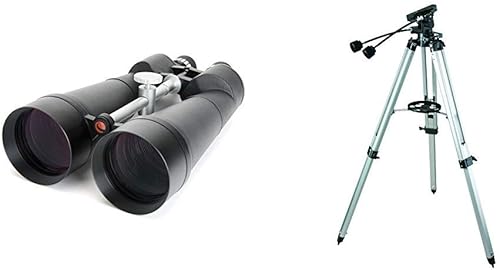
Celestron Celestron SkyMaster 25x100 Giant Astronomy Binoculars

Celestron SkyMaster 25x100 Giant Astronomy Binoculars

Brand: Celestron

Best for

Serious stargazers who want maximum aperture astronomy binoculars for revealing faint galaxies, nebulae and star clusters at 25x magnification with 100mm objective lenses that gather significantly more light than 70mm models.

Skip if

Handheld use is intended. The SkyMaster 25x100 requires a tripod at 25x magnification and with 100mm objectives weighing over 4 pounds. These binoculars must be mounted on a sturdy tripod with a binocular mount adapter for comfortable observing.

The SkyMaster 25x100 provides 100mm of aperture per eye, which gathers 2.04x more light than 70mm objectives. At 25x magnification, the 100mm aperture resolves star clusters in detail, shows the Andromeda galaxy's companion galaxies M32 and M110 and reveals emission nebulae that the 70mm SkyMaster shows only faintly.

The 4mm exit pupil at 25x magnification delivers a bright image even under moderately light-polluted skies. Exit pupil is calculated as objective aperture divided by magnification; 4mm matches well with the typical dark-adapted pupil size for observers over 40.

A sturdy tripod is not optional for the 25x100. At 25x, any hand tremor produces image shake that makes observation uncomfortable. A parallelogram binocular mount allows reclining while keeping the binoculars aimed at the target.

What buyers say

Serious stargazers who want maximum aperture astronomy binoculars for revealing faint galaxies say Celestron SkyMaster 25x100 Giant Astronomy Binoculars does what it describes without needing adjustments out of the box. Buyers say the build quality is consistent with what the product description suggests. Buyers who find themselves in a position where handheld use is intended say a different option makes more sense for their situation.

Specifications

Specifications for Celestron SkyMaster 25x100 Giant Astronomy Binoculars
Objective aperture100mm
Magnification25x
Exit pupil4mm
Price$459

Specs from Celestron, SkyMaster 25x100 product page
02
Best value astronomy binoculars
Celestron Celestron SkyMaster 25x70 Binoculars for Astronomy

Celestron SkyMaster 25x70 Binoculars for Astronomy

Brand: Celestron

Best for

Beginners entering astronomy binocular viewing who want 70mm aperture at 25x magnification at the most accessible price, with Celestron's BaK-4 prism optics and a tripod adapter included.

Skip if

Handheld stargazing is the intent. The SkyMaster 25x70 at 25x magnification requires a tripod for steady views. For comfortable handheld night sky viewing, a 10x50 binocular (standard travel binoculars) is steadier and more practical than high-magnification astronomy binoculars.

The SkyMaster 25x70 at $119 is the most popular entry point for astronomy binoculars in Celestron's lineup. The 70mm objective lenses gather 100 times more light than the human eye's 7mm dark-adapted pupil, revealing star clusters, bright nebulae and nearby galaxies as clearly as a small telescope.

BaK-4 porro prisms provide better edge-of-field sharpness and contrast than BK-7 prisms found in budget binoculars. Porro prism designs also produce brighter images than roof prism designs at the same aperture, which matters for astronomy where image brightness is directly tied to the ability to see faint objects.

At $119, the SkyMaster 25x70 provides the most aperture per dollar in astronomy binoculars. A tripod is necessary for steady observation; any standard photo tripod with a binocular adapter (included) provides stable views.

What buyers say

Most buyers fitting the profile of beginners entering astronomy binocular viewing who want 70mm aperture at 25x magnification at the most accessible price report Celestron SkyMaster 25x70 Binoculars for Astronomy meets their expectations across regular use. Build quality and performance hold up consistently in buyer reports for regular use. The common reason buyers pass on it is when handheld stargazing is the intent.

Specifications

Specifications for Celestron SkyMaster 25x70 Binoculars for Astronomy
Objective aperture70mm
Magnification25x
Prism typeBaK-4 porro prism
Price$119

Specs from Celestron, SkyMaster 25x70 product page

03
Best mid-aperture astronomy binoculars
Celestron Celestron SkyMaster 15x70 Astronomy Binoculars

Celestron SkyMaster 15x70 Astronomy Binoculars

Brand: Celestron

Best for

Buyers who want 70mm aperture with 15x magnification rather than 25x, providing a wider field of view and more forgiving tripod-free holding for observers who find high-magnification binoculars difficult to hold steady.

Skip if

Maximum magnification is wanted. The SkyMaster 15x70 at 15x provides a wider field than the 25x70. For individual resolved views of star clusters and the most magnified views of the Moon, the 25x70 provides more detail. The 15x70 is better for wide-field sweeping and scanning the Milky Way band.

The SkyMaster 15x70 at 15x magnification provides a wider true field of view than the 25x70 at the same aperture. Wide true field is valuable for sweeping the Milky Way, finding open star clusters and observing large objects like the Pleiades and Hyades that are too large to fit in a high-magnification view.

At 15x, some observers can hand-hold the SkyMaster 15x70 for short sessions against a fixed support (leaning against a wall, reclining in a chair). At 25x, any movement makes stable viewing nearly impossible without a tripod.

At $89, the 15x70 is $30 less than the 25x70 for the same aperture at lower magnification. For beginners who want to start with astronomy binoculars that are more forgiving on a tripod or even handheld, the 15x70 is the more approachable choice.

What buyers say

Buyers say Celestron SkyMaster 15x70 Astronomy Binoculars delivers on its stated purpose without hidden trade-offs in the first several uses. The group most consistently satisfied is buyers who want 70mm aperture with 15x magnification rather than 25x, who say it handles their specific use case reliably. Where buyers recommend looking elsewhere is when maximum magnification is wanted.

Specifications

Specifications for Celestron SkyMaster 15x70 Astronomy Binoculars
Objective aperture70mm
Magnification15x
Field of viewWider than 25x models
Price$89

Specs from Celestron, SkyMaster 15x70 product page

04
Best high-powered astronomy binoculars
Large aperture 20x80 High-Powered Astronomy Binoculars

20x80 High-Powered Astronomy Binoculars

Brand: Large aperture

Best for

Observers who want the middle ground between 70mm and 100mm aperture at 20x magnification, with 80mm objectives providing more light than 70mm models in a package lighter than the 100mm models.

Skip if

Brand support and warranty are priorities. 20x80 binoculars at this price tier are typically from lesser-known brands. For Celestron brand quality and support, the SkyMaster 25x70 at $119 and SkyMaster 25x100 at $459 provide the established brand alternative.

The 20x80 binoculars provide 80mm aperture that gathers 31% more light than 70mm objectives, a step up from the SkyMaster 25x70 at a lower magnification than the 25x version. The 20x magnification is a practical sweet spot that shows significantly more than 10x binoculars while remaining manageable on a standard photo tripod.

At 20x magnification, globular clusters resolve individual outer stars, the Andromeda galaxy shows its elliptical form clearly and faint nebulae begin to show detail. This represents a meaningful observing step beyond the 15x70 class.

At $239, the 20x80 sits between the Celestron 25x70 and 25x100 in both aperture and price. For observers specifically wanting 80mm over 70mm without the size and weight of the 100mm SkyMaster, the 20x80 fills the gap.

What buyers say

Buyers point out that when brand support and warranty are priorities, a different product is the stronger fit. Outside that situation, 20x80 High-Powered Astronomy Binoculars gets straightforward positive feedback from people using it as intended. For observers who want the middle ground between 70mm and 100mm aperture at 20x magnification, the performance buyers report is consistently positive across the product's intended use.

Specifications

Specifications for 20x80 High-Powered Astronomy Binoculars
Objective aperture80mm
Magnification20x
Exit pupil4mm
Price$239

Specs from 20x80 Astronomy Binoculars, Amazon search

Reading astronomy binocular specifications

Astronomy binoculars are described by two numbers: magnification x objective aperture, for example 25x70.

  • 25 = magnification (objects appear 25x larger than naked eye)
  • 70 = objective lens diameter in mm (light-gathering aperture per eye)

Exit pupil = objective diameter / magnification. The SkyMaster 25x70 has a 2.8mm exit pupil. For comparison, a dark-adapted human eye dilates to 5-7mm. A larger exit pupil is brighter per area; a smaller exit pupil concentrates more of the available light into a smaller beam.

True field of view decreases as magnification increases for a fixed aperture. A 15x70 shows more sky than a 25x70. Wide field is useful for sweeping and finding objects; narrow field reveals more detail in the center.

Aperture comparison table

Model Aperture Light vs eye Best for
10x50 50mm 51x General stargazing, handheld
15x70 70mm 100x Wide-field, Milky Way sweeping
25x70 70mm 100x Star clusters, nebulae detail
20x80 80mm 131x Mid-aperture deep sky
25x100 100mm 204x Faint galaxies, globulars

All apertures above 50mm require tripod support at the listed magnifications.

Objects best observed with astronomy binoculars

Object Why binoculars excel
Milky Way sweeps Wide field shows star field context
Open clusters Full cluster fits in field at 15-25x
Andromeda galaxy Large enough to show full extent
Orion Nebula Wide field includes context stars
Jupiter's moons Easy to find in wide field
Double stars Most pairs resolved at 25x
Moon surface No eye adjustment needed

Compare the picks

Side by side comparison of every pick
Specification
Celestron Celestron SkyMaster 25x100 Giant Astronomy Binoculars
Celestron SkyMaster 25x100 Giant Astronomy Binoculars
Celestron Celestron SkyMaster 25x70 Binoculars for Astronomy
Celestron SkyMaster 25x70 Binoculars for Astronomy
Celestron Celestron SkyMaster 15x70 Astronomy Binoculars
Celestron SkyMaster 15x70 Astronomy Binoculars
Large aperture 20x80 High-Powered Astronomy Binoculars
20x80 High-Powered Astronomy Binoculars
Our verdictBest premium astronomy binocularsBest value astronomy binocularsBest mid-aperture astronomy binocularsBest high-powered astronomy binoculars
Objective aperture100mm70mm70mm80mm
Magnification25x25x15x20x
Exit pupil4mmNot listedNot listed4mm
Price$459$119$89$239
Prism typeNot listedBaK-4 porro prismNot listedNot listed
Field of viewNot listedNot listedWider than 25x modelsNot listed
BuyCheck priceCheck priceCheck priceCheck price

Questions people ask

Can astronomy binoculars replace a telescope for beginners?

Astronomy binoculars are a practical and often recommended starting point before a telescope purchase. They provide two-eyed viewing which many observers find more comfortable than single-eye telescope viewing, a wide field of view that makes finding objects easier, immediate use without alignment or assembly, and the same binoculars useful for terrestrial daytime activities. The limitation is magnification: binoculars typically provide 15-25x versus a telescope's 50-300x range. For observing planets, a telescope is necessary for meaningful magnification. For star clusters, nebulae and wide-field Milky Way sweeping, large-aperture binoculars provide rewarding views that complement a telescope.

What tripod should I use with astronomy binoculars?

Any photo tripod rated for 8-12 pounds holds astronomy binoculars adequately. Look for a fluid head or ball head that allows smooth vertical movement for tracking objects. For 25x100 binoculars that point near the zenith, a parallelogram binocular mount is more comfortable than a standard tripod head because it allows the eyepieces to stay at a comfortable angle regardless of where the binoculars point. A standard photo tripod works for targets at medium altitudes but becomes awkward pointing overhead. Most astronomy binoculars include a 1/4-20 threaded adapter for standard tripod attachment.

What can I see with 25x70 astronomy binoculars that I cannot see naked eye?

With 25x70 binoculars from a suburban sky, you can see: the Andromeda galaxy as an oval glow rather than a faint smudge; star clusters like the Pleiades fully resolved with dozens of stars visible; the Orion Nebula as a green-gray cloud; the double cluster in Perseus; Jupiter's four Galilean moons as four small dots; Saturn as a slightly non-circular star (the rings are discernible as an elongated shape); and the Milky Way resolved into thousands of individual stars rather than a diffuse glow. The Moon reveals crater detail at any magnification above 10x. From dark skies, faint nebulae and distant galaxies become visible that require dark adaptation and optical aid to see at all.