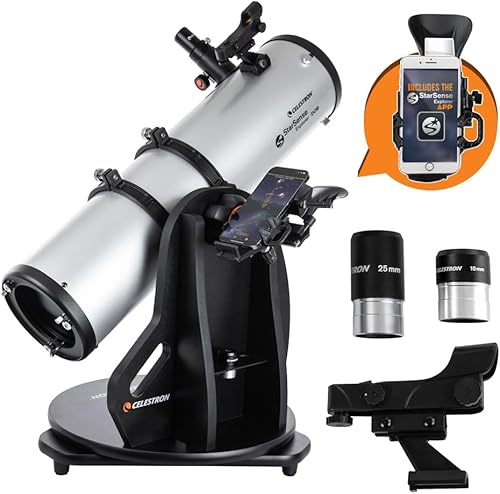
Schmidt-Cassegrain telescope: best Celestron picks on Amazon

Schmidt-Cassegrain telescopes combine a wide corrector plate with a Cassegrain mirror system for a compact design that covers both planetary and deep-sky targets.

By Pickspry EditorialUpdated 4 picks


The short answer

The Celestron NexStar 6SE Schmidt-Cassegrain at $1,199 is the best SCT for most buyers: 6-inch aperture in a compact tube with GoTo on a single-fork mount balances planetary sharpness and deep-sky light-gathering. The NexStar 8SE at $1,699 adds two more inches of aperture for significantly brighter nebulae and galaxy detail.

Product buttons open Amazon search results. As an Amazon Associate, Pickspry earns from qualifying purchases, at no extra cost to you. Learn more

Quick picks

How we chose

Schmidt-Cassegrain telescopes are evaluated by aperture (mm), focal length, GoTo mount inclusion, mount type and whether a StarSense smartphone app dock is included. Non-GoTo SCTs are noted. Specs from Celestron manufacturer product pages. We did not test these products.

The picks, in detail

4 picks reviewed
01
Best Schmidt-Cassegrain for visual deep sky
Celestron Celestron NexStar 8SE Schmidt-Cassegrain GoTo Telescope

Celestron NexStar 8SE Schmidt-Cassegrain GoTo Telescope

Brand: Celestron

Best for

Serious amateur astronomers who want the most aperture in the NexStar SE line for the deepest views of nebulae, galaxies and globular clusters while maintaining the portable single-fork GoTo mount that the SE series uses.

Skip if

Budget is under $1,500. The NexStar 8SE at $1,699 is the premium tier SCT. The NexStar 6SE at $1,199 provides the same GoTo system with two less inches of aperture at $500 less. For buyers who observe primarily planets rather than deep-sky objects, the 6SE provides sufficient aperture.

The Celestron NexStar 8SE's 8-inch (203mm) aperture provides 78% more light-gathering than the 6SE and 2.5 times more than the 5SE. At this aperture level, the visual difference in deep-sky objects is dramatic compared to smaller SCTs: galaxy dust lanes become visible, globular clusters fully resolve to individual stars at the core and faint planetary nebulae show clear discs.

The 2,032mm focal length at F10 produces high magnification across the focal plane, which is ideal for planetary observation. Saturn's Cassini division, Jupiter's cloud band detail and features on Mars at opposition are visible at the high magnification the 8SE provides.

The single-fork GoTo alt-azimuth mount uses the same SkyAlign and 40,000-object database as the smaller SE models. The 8-inch OTA is balanced on the single-fork arm; a wedge accessory converts the mount to equatorial tracking for long-exposure photography.

What buyers say

Serious amateur astronomers who want the most aperture in the NexStar SE line for the deepest views of nebulae say Celestron NexStar 8SE Schmidt-Cassegrain GoTo Telescope does what it describes without needing adjustments out of the box. Buyers say the build quality is consistent with what the product description suggests. Buyers who find themselves in a position where budget is under $1,500 say a different option makes more sense for their situation.

Specifications

Specifications for Celestron NexStar 8SE Schmidt-Cassegrain GoTo Telescope
Aperture8-inch (203mm)
Focal length2,032mm F10
MountSingle-fork GoTo alt-azimuth
Price$1,699

Specs from Celestron, NexStar 8SE product page
02
Best Schmidt-Cassegrain overall
Celestron Celestron NexStar 6SE Schmidt-Cassegrain GoTo Telescope

Celestron NexStar 6SE Schmidt-Cassegrain GoTo Telescope

Brand: Celestron

Best for

The most popular aperture in the NexStar SE line. The 6SE's 6-inch aperture strikes the balance that most observers find optimal: light enough to set up in one trip, large enough to show nebulae, galaxies and planets with satisfying detail.

Skip if

Maximum portability matters most. The NexStar 5SE is smaller and lighter while providing the GoTo experience and good planetary performance. The 6SE's 6-inch OTA is noticeably heavier than the 5SE and requires both hands to mount. For observers who value compact portability equally with aperture, the 5SE is an alternative.

The NexStar 6SE is consistently the most recommended intermediate GoTo telescope because the 6-inch aperture crosses a capability threshold where deep-sky observation becomes consistently rewarding. Compared to 4-inch telescopes, the 6SE's aperture reveals the Andromeda galaxy's satellite galaxies as separate objects, resolves the Hercules Globular Cluster and shows detail in bright nebulae.

The Schmidt-Cassegrain design's 1,500mm focal length at F10 provides the long focal length needed for planetary magnification in a tube length of approximately 12 inches. A 6-inch refractor with equivalent focal length would be over 4 feet long; the folded SCT optical path compresses this to a portable size.

SkyAlign requires pointing at any three bright objects. After alignment, the hand controller provides access to 40,000 objects by name or catalog number. The mount tracks objects once found.

What buyers say

Most buyers fitting the profile of the most popular aperture in the NexStar SE line. The 6SE's 6-inch aperture strikes the balance that most observers find optimal: light enough to set up in one trip report Celestron NexStar 6SE Schmidt-Cassegrain GoTo Telescope meets their expectations across regular use. Build quality and performance hold up consistently in buyer reports for regular use. The common reason buyers pass on it is when maximum portability matters most.

Specifications

Specifications for Celestron NexStar 6SE Schmidt-Cassegrain GoTo Telescope
Aperture6-inch (150mm)
Focal length1,500mm F10
MountSingle-fork GoTo alt-azimuth
Price$1,199

Specs from Celestron, NexStar 6SE product page

03
Best compact SCT with smartphone app
Celestron Celestron StarSense Explorer DX 5-Inch Schmidt-Cassegrain

Celestron StarSense Explorer DX 5-Inch Schmidt-Cassegrain

Brand: Celestron

Best for

Buyers who want a 5-inch SCT with Celestron's StarSense smartphone app navigation on an alt-azimuth mount at a price below the NexStar SE series, trading motorized GoTo for smartphone-assisted manual navigation.

Skip if

Fully automatic GoTo is required. The StarSense DX uses smartphone-assisted navigation where arrows on the screen guide you to the target manually; the mount does not slew automatically. For fully motorized GoTo that moves without user pushing, the NexStar 5SE or 6SE is the appropriate choice.

The StarSense Explorer DX 5-inch SCT uses the StarSense smartphone app to navigate to objects by displaying arrows on-screen that tell you which direction to push the telescope. The phone's camera reads star positions against the sky and calculates where the telescope is pointing in real time.

The 5-inch (127mm) Maksutov-Cassegrain design provides high-contrast planetary views. The long focal length and closed optical path of the Cassegrain design produce sharp, high-contrast images of the Moon, planets and double stars. The StarSense app provides access to 120,000 objects in its catalog.

At $589, the StarSense DX 5-inch provides the largest SCT aperture with smartphone navigation at the most accessible price in the GoTo/app-assisted Schmidt-Cassegrain class, below the NexStar 5SE's motorized GoTo at the same aperture.

What buyers say

Buyers say Celestron StarSense Explorer DX 5-Inch Schmidt-Cassegrain delivers on its stated purpose without hidden trade-offs in the first several uses. The group most consistently satisfied is buyers who want a 5-inch SCT with Celestron's StarSense smartphone app navigation on an alt-azimuth mount at a price below the NexStar SE series, who say it handles their specific use case reliably. Where buyers recommend looking elsewhere is when fully automatic GoTo is required.

Specifications

Specifications for Celestron StarSense Explorer DX 5-Inch Schmidt-Cassegrain
Aperture5-inch (127mm)
AppStarSense smartphone navigation
MountManual alt-azimuth with app
Price$589

Specs from Celestron, StarSense Explorer DX 5-inch product page

04
Best entry SCT GoTo telescope
Celestron Celestron NexStar 5SE Schmidt-Cassegrain GoTo Telescope

Celestron NexStar 5SE Schmidt-Cassegrain GoTo Telescope

Brand: Celestron

Best for

Buyers who want the full NexStar SE GoTo experience in the smallest and most portable configuration, with a 5-inch aperture that provides excellent planetary views and access to bright deep-sky objects.

Skip if

Deep-sky observations of faint nebulae and galaxies are the priority. The 5SE's 5-inch aperture performs less well on faint extended objects compared to the 6SE or 8SE. For regular deep-sky observation, the additional aperture of the 6SE is more useful than the 5SE's portability advantage.

The NexStar 5SE is the smallest-aperture model in the SE series with the full single-fork GoTo alt-azimuth mount. The 5-inch aperture provides excellent planetary performance: Saturn's rings and Cassini division, Jupiter's cloud bands, Mars's polar caps at opposition and lunar crater detail are all clearly visible.

The 5SE's single-fork mount and 5-inch tube make it the most portable full-GoTo SCT in the NexStar SE series. Setup weight is approximately 18 pounds for the mount and OTA combined, allowing carry in one bag for dark-sky trips.

The same SkyAlign and 40,000-object database as the larger SE models provides the identical GoTo user experience. For observers who observe planets frequently and move to different sites regularly, the 5SE provides the GoTo experience in the most portable format.

What buyers say

Buyers point out that when deep-sky observations of faint nebulae and galaxies are the priority, a different product is the stronger fit. Outside that situation, Celestron NexStar 5SE Schmidt-Cassegrain GoTo Telescope gets straightforward positive feedback from people using it as intended. For buyers who want the full NexStar SE GoTo experience in the smallest, the performance buyers report is consistently positive across the product's intended use.

Specifications

Specifications for Celestron NexStar 5SE Schmidt-Cassegrain GoTo Telescope
Aperture5-inch (127mm)
Focal length1,250mm F10
MountSingle-fork GoTo alt-azimuth
Price~$799

Specs from Celestron, NexStar 5SE product page

The SCT design solves a problem in telescope portability: how to provide a long focal length in a short tube.

A refractor with 1,500mm focal length would be 5 feet long. The SCT folds the light path by reflecting it between the primary and secondary mirrors, compressing the tube to roughly 12 inches for the same focal length.

SCT advantages:

  • Long focal length in compact form
  • Versatile for planets AND deep-sky
  • Rear-cell focuser allows accessory changes without rebalancing
  • Compatible with large accessory ecosystem (reducers, cameras, wedges)

SCT trade-offs:

  • Higher cost than Newtonian reflectors at same aperture
  • Longer cool-down time than open-tube designs
  • Central obstruction from secondary reduces contrast slightly

NexStar SE aperture comparison

Model Aperture Price Best for
5SE 5-inch ~$799 Portable, planetary
6SE 6-inch $1,199 Balanced all-around
8SE 8-inch $1,699 Deep-sky and planetary

Each aperture step provides meaningfully more light. The 6SE collects 44% more light than the 5SE; the 8SE collects 78% more than the 6SE. These differences are visible at the eyepiece on nebulae and galaxies.

Accessories that improve SCT performance

Accessory What it does Best for
F6.3 focal reducer Widens field, brightens image Deep-sky photography
Equatorial wedge Converts to EQ tracking Long-exposure photography
Barlow 2x Doubles magnification Planetary detail
Visual back Accepts 2-inch eyepieces Wider field views

Compare the picks

Side by side comparison of every pick
Specification
Celestron Celestron NexStar 8SE Schmidt-Cassegrain GoTo Telescope
Celestron NexStar 8SE Schmidt-Cassegrain GoTo Telescope
Celestron Celestron NexStar 6SE Schmidt-Cassegrain GoTo Telescope
Celestron NexStar 6SE Schmidt-Cassegrain GoTo Telescope
Celestron Celestron StarSense Explorer DX 5-Inch Schmidt-Cassegrain
Celestron StarSense Explorer DX 5-Inch Schmidt-Cassegrain
Celestron Celestron NexStar 5SE Schmidt-Cassegrain GoTo Telescope
Celestron NexStar 5SE Schmidt-Cassegrain GoTo Telescope
Our verdictBest Schmidt-Cassegrain for visual deep skyBest Schmidt-Cassegrain overallBest compact SCT with smartphone appBest entry SCT GoTo telescope
Aperture8-inch (203mm)6-inch (150mm)5-inch (127mm)5-inch (127mm)
Focal length2,032mm F101,500mm F10Not listed1,250mm F10
MountSingle-fork GoTo alt-azimuthSingle-fork GoTo alt-azimuthManual alt-azimuth with appSingle-fork GoTo alt-azimuth
Price$1,699$1,199$589~$799
AppNot listedNot listedStarSense smartphone navigationNot listed
BuyCheck priceCheck priceCheck priceCheck price

Questions people ask

What is the difference between a Schmidt-Cassegrain and a Maksutov-Cassegrain telescope?

Both are compact compound telescope designs that fold a long focal length into a short tube. The Schmidt-Cassegrain (SCT) uses a thin corrector plate with a slight lens shape at the front of the tube, with a primary mirror behind it and a secondary mirror on the corrector plate reflecting light back through a hole in the primary to the focuser. The Maksutov-Cassegrain uses a thick meniscus corrector lens rather than a thin plate, with a silvered spot on the corrector serving as the secondary mirror. In practice, Maksutov designs tend to produce slightly sharper, higher-contrast planetary images while SCTs provide a flatter field for astrophotography. SCTs have a larger secondary mirror that slightly reduces contrast compared to Maksutov designs of the same aperture. For most buyers, the differences are minor compared to aperture differences.

Can a Schmidt-Cassegrain telescope be used for astrophotography?

Yes, Schmidt-Cassegrain telescopes are widely used for astrophotography, particularly for planetary and lunar imaging at high magnification and for deep-sky imaging with a focal reducer. For deep-sky astrophotography, the standard F10 focal ratio produces a narrow field that is better suited for smaller targets. An F6.3 focal reducer/corrector shortens the focal length and flattens the field for wider deep-sky imaging. For long-exposure deep-sky photography, the telescope must be mounted on an equatorial wedge (converting the alt-azimuth mount to equatorial) to allow accurate tracking without field rotation. GoTo alt-azimuth mounts cause field rotation during long exposures that prevents sharp stars in long exposures.

How long does a Schmidt-Cassegrain telescope take to thermally cool down?

A Schmidt-Cassegrain telescope needs 30-90 minutes to thermally equilibrate after being brought from a warm indoor environment to outdoor temperatures. The thick corrector plate and large primary mirror store heat that escapes slowly. Before cooling is complete, images show wavy heat distortion that limits resolution. Cool-down time depends on the temperature difference between indoors and outdoors. Transporting the telescope outdoors 1-2 hours before the intended observation session begins allows viewing at optimal resolution when the session starts. Some observers store their telescope in a garage or shed at outdoor temperatures to eliminate cool-down time entirely.